
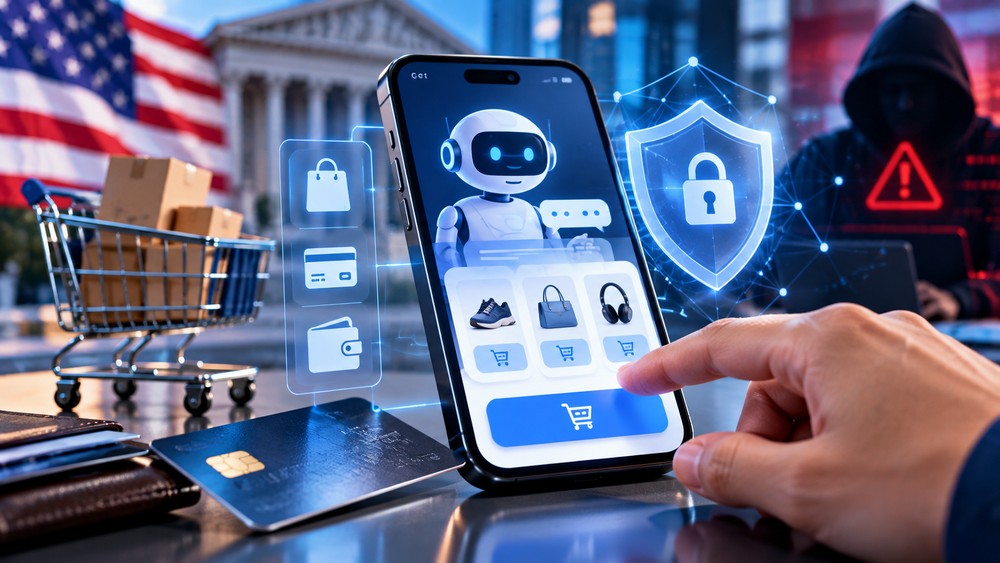
AI agents are moving from recommending products to actually buying them. That shift is prompting banks to demand clearer safeguards around payments, fraud and financial data. Bank of America, Capital One, NatWest, ING, ASB Bank and Commonwealth Bank of Australia have jointly published principles aimed at making so-called agentic commerce safer and more transparent.
When AI does more than recommend
Chatbots have mostly been used to search, compare and explain products. Agentic commerce goes further: an AI system can receive an instruction, select an item and potentially complete a payment on the customer’s behalf.
Reuters reports that the banks involved see real potential in the technology, but warn that its development is moving faster than industry standards and existing consumer protections.
The risks banks are worried about
The central issue is not AI itself, but what an agent is allowed to do, which data it can access and who is responsible when something goes wrong.
- Financial data: an agent may need access to sensitive card or payment information.
- Authorization: consumers need to know exactly which actions they have approved.
- Fraud: agents, merchants or digital identities could be compromised or impersonated.
- Liability: if an agent buys the wrong item or makes an unwanted payment, the route to compensation may be unclear.
- Choice: an AI agent should not quietly steer users toward payment methods with weaker protections.
Five principles for trusted AI commerce
The joint banking paper focuses on five areas: transparency, safety, privacy and data, choice and interoperability. Consumers should know when AI is involved, remain in control of how payments are made and understand how their data is being used.
The banks also want clearer information about how agents make decisions, as well as systems that can work together so consumers and merchants are not locked into a single AI-commerce platform.
AI-driven shopping is already growing
This is not only a future scenario. Reuters reported that British retailer John Lewis said searches originating from AI agents had increased to 2.5% of its total, from 0.3% a year earlier. The share is still small, but the pace of growth shows how quickly online shopping behavior may change.
What consumers should watch
There is a major difference between asking AI to find the best price and allowing an AI agent to access a payment method and spend money autonomously. Until standards and liability rules become clearer, consumers should check permissions carefully, use trusted services, verify merchants and understand whether an AI tool is merely recommending or is actually authorized to transact.
The bottom line
Agentic commerce could make shopping faster and more convenient, but it also shifts part of the purchasing process from the consumer to software. The banks are not calling for the technology to be stopped. Their message is that security, transparency and accountability need to develop as quickly as the agents themselves.
Sources: Reuters, September 22, 2026; NatWest Group, “Global banks collaborate on principles for trusted agentic commerce,” September 22, 2026.
Rispondi